

Investing at All-Time Highs: Should You Be Worried?
When markets reach record highs, it’s natural to wonder whether you’ve missed the opportunity or whether it’s time to step aside. History suggests investors should think differently.
Markets hitting record highs often make headlines.
For some investors, it’s a sign that the economy is performing well and businesses continue to create value. For others, it can feel like a warning signal. Surely markets cannot keep climbing forever?
Questions like these are entirely understandable.
- Should I wait for a correction before investing?
- Should I reduce my exposure while markets are high?
- Would it be better to lock in recent gains before prices fall?
These thoughts are perfectly normal. After all, nobody wants to invest just before a downturn.
The challenge is that our instincts don’t always lead to better investment decisions.
The problem with trying to time the market
Deciding to leave the market is only half the challenge.
You also need to know when to return.
Getting one decision right is difficult enough. Getting both consistently right over decades of investing is another matter entirely.
History shows that even professional fund managers, supported by teams of analysts and sophisticated research, struggle to consistently predict short-term market movements.
Markets are influenced by countless factors including interest rates, inflation, company earnings, geopolitics and investor expectations. By the time news reaches the headlines, much of that information has already been reflected in prices.
Rather than attempting to predict the next move, long-term investors are generally better served by maintaining a diversified portfolio aligned with their goals and remaining invested through changing market conditions.
Record highs are more common than many investors realise
One reason market highs can feel uncomfortable is that we naturally assume they are unusual.
In reality, they are a normal feature of long-term investing.
Over time, successful businesses innovate, grow their earnings, reinvest capital and adapt to changing economic conditions. As companies create more value, markets tend to rise alongside them.
That means new highs should not be viewed as extraordinary events. They are often simply evidence of long-term economic progress.
Since 1990, developed equity markets have reached all-time highs on more than 650 trading days.
Figure 1: Developed stock market returns and all-time highs (1990–2026)
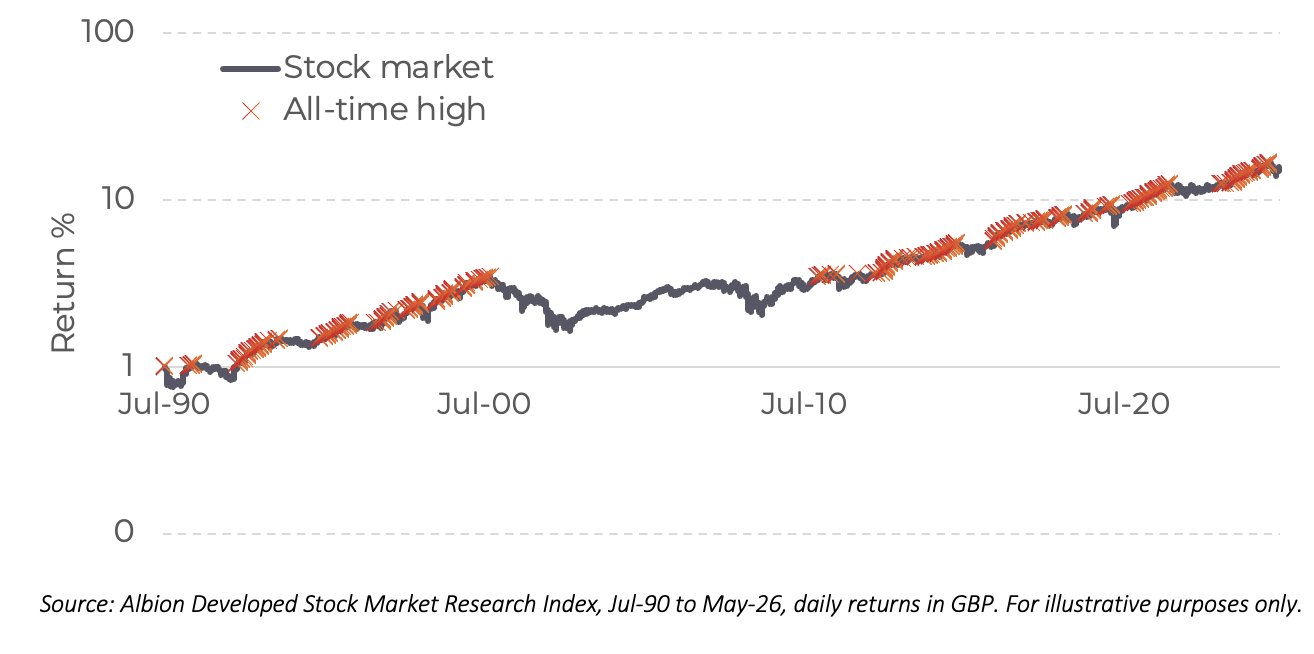
Instead of asking why markets are reaching new highs, investors might consider asking why they wouldn’t.
If long-term returns are expected to be positive, markets should naturally spend a considerable amount of time setting new records.
Does investing at a market high lead to poor outcomes?
Many investors assume that buying at a market peak inevitably leads to disappointing returns.
The evidence suggests otherwise.
Research by JP Morgan examined returns from investing in the S&P 500 between January 1988 and August 2026.
Perhaps surprisingly, investors who invested on days when the market reached an all-time high experienced positive returns over the following 12 months 88% of the time.
By comparison, investing on a randomly selected day produced positive 12-month returns 83% of the time.
Average returns following market highs were also slightly stronger over one, three and five-year periods.
This does not mean that markets cannot fall immediately after reaching a new high.
They certainly can.
Nor does it guarantee that future market highs will always be followed by positive returns.
What the research demonstrates is something much simpler: reaching an all-time high does not, by itself, increase the likelihood of an imminent market decline.
Headlines are not investment signals
Financial headlines often portray record market highs as remarkable events.
In reality, they are simply one point on a much longer journey.
If investors become nervous every time markets reach a new peak, they risk spending much of their investment lifetime waiting for a correction that may not arrive when expected.
Even when markets do decline, predicting both the fall and the subsequent recovery is exceptionally difficult.
Missing just a handful of strong recovery days can have a significant impact on long-term wealth creation.
This is why reacting emotionally to headlines often proves more costly than the market volatility investors were trying to avoid.
Focus on what you can control
Rather than trying to predict the next market correction, investors are generally better served by focusing on the factors they can control.
These include:
• Maintaining a diversified portfolio
• Investing according to your long-term objectives
• Keeping investment costs under control
• Remaining disciplined during periods of uncertainty
• Holding an appropriate mix of equities and bonds based on your personal circumstances
A well-constructed financial plan already assumes that markets will experience periods of decline.
Volatility is not an unexpected event to be feared. It is an expected part of investing.
The objective is not to eliminate market falls but to build a portfolio capable of weathering them.
Final thoughts
Every all-time high can feel like a decision point.
- Should I invest?
- Should I wait?
- Should I sell?
History suggests that these questions are often driven more by emotion than evidence.
Markets have always experienced periods of uncertainty, corrections and recoveries. Yet over the long term, they have also continued to reach new highs as businesses innovate, economies grow and investors are rewarded for taking on risk.
At Pyrmont Wealth, we believe successful investing is built on discipline rather than prediction.
Because while nobody knows where markets will be next month or next year, history suggests that staying invested has consistently given long-term investors the greatest opportunity to achieve their financial goals.
Stay invested. Stay focused. Stay disciplined.
Important Information
This article is for educational purposes only and does not constitute financial advice or a recommendation to invest. The value of investments can fall as well as rise, and past performance is not a reliable indicator of future results.


About Post Author
